De Boville Family Tomb
Tess of the d'UrbervillesThe d’Urberville family vault is the ancestral burial place beneath the d’Urberville Aisle in the church at Kingsbere. In the family’s moment of displacement, it offers a brief, makeshift shelter while exposing the gulf between a once-powerful lineage and its impoverished descendants: the family can claim the vault as an ancestral possession, but it cannot secure a roof or a home. For Tess, the damaged tombs make that social collapse tangible, and the church becomes the setting for another encounter with Alec.
Location and Physical Setting
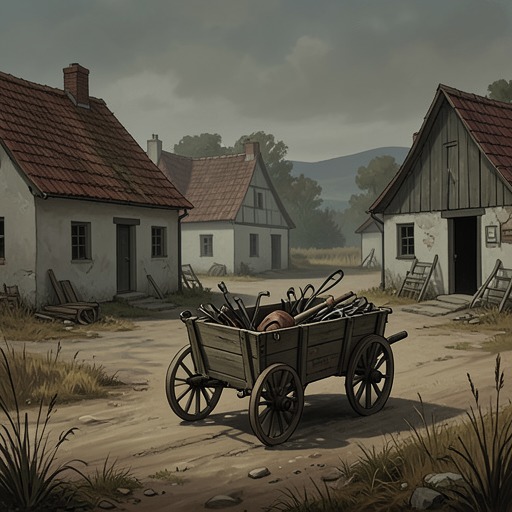
The vaults lie beneath the south wall of the church, in the aisle known as the d’Urberville Aisle. The family’s household goods have been unloaded beside the churchyard wall, and Tess’s mother proposes that they camp in their family vault until they can find proper shelter. A four-post bedstead is set up beneath the aisle’s south wall; its curtains are drawn around the bed to make a tent for the younger children. Above it is the fifteenth-century d’Urberville Window, whose heraldic emblems recall those on John Durbeyfield’s old seal and spoon.
The setting places the family’s most ordinary possessions—beds, crockery, kettles, dried herbs, and a clock—beside its monumental past. Outside, the surrounding hills and slopes have been divided into small paddocks, while the green foundations mark where the d’Urberville mansion once stood. A stretch of Egdon Heath, formerly belonging to the estate, remains nearby. The church and vault thus stand amid visible traces of a landed domain that has been broken up, while the household goods exposed beside them show the family’s immediate material need.
Tombs and the Evidence of Decline
Tess enters the church for the first time in her life while left with the children. Inside, she finds the family tombs beneath the window, their dates extending across several centuries. They are canopied and altar-shaped, but their carvings are defaced and broken; the brass memorials have been torn away, leaving only their rivet holes. Rather than affirming living power, the tombs show the remnants of a lineage whose monuments have been stripped and neglected.
The contrast gives the vault particular force for Tess. The heraldic symbols and the ancestral burial place connect her family to its aristocratic history, but the damaged memorials offer no practical remedy for poverty or displacement. Tess reads their condition as the clearest reminder she has received that her people are socially extinct. The vault preserves the family’s name and burial claims even as its ruined surfaces make the loss of status unmistakable.
The Inscription and Ancestral Identity
Tess approaches a dark stone bearing the Latin inscription “OSTIUM SEPULCHRI ANTIQUAE FAMILIAE D'URBERVILLE”. Although she cannot read Church Latin fluently, she understands that it marks the entrance to her ancestral sepulchre. The reference confirms the connection between the family name and the people buried within: these are the knights of whom John Durbeyfield had spoken with pride.
That recognition sharpens the difference between ancestry as inheritance and ancestry as present security. The sepulchre and its emblems attest to an illustrious past, but the family has arrived at Kingsbere without a home and must improvise shelter among the church’s surroundings. The vault is at once a real family possession and an inadequate answer to the needs of the living. Its history can be named and its dead can be identified, but neither fact restores the household’s lost position.
Tess and Alec in the Church
After remaining with the children, Tess walks through the churchyard and enters the church. As she turns to leave, she notices what appears to be a recumbent figure on the oldest altar-tomb. The figure is not an effigy but Alec, who has been lying on the tomb and rises to support her when she is overcome by surprise. He says that he saw her enter and had got up there so as not to interrupt her meditations, then invokes the setting as a family gathering among the dead.
Tess tells him to go away. As he passes, he replies that he will look for her mother, but adds a threatening assurance that she will yet be civil to him. After he has gone, Tess bends over the entrance to the vaults and asks why she is on the wrong side of the door. The moment binds the place of ancestral burial to her sense of present danger and exclusion: the vault holds the family dead, but it cannot remove Alec from the church or shield Tess from his renewed pursuit.
Narrative Significance
The vault’s significance arises from the collision of past grandeur with present precarity. The family’s claim to a freehold burial place contrasts with its inability to find a dwelling; the heraldic window and ancient tombs survive beside broken memorials and the remains of a dismantled estate. By turning the church aisle into a temporary camp, the episode makes inherited rank serve first as shelter for the family’s bed and children, not as a source of social power.
The scene also makes the vault a threshold between household need, ancestral memory, and immediate threat. Tess’s recognition of the inscription briefly gives the family past a concrete form, but Alec’s appearance on the tomb overturns any suggestion that the church is a protected refuge. Her question at the vault entrance registers the painful gap between being descended from the dead within and finding no secure place among the living outside. The ancestral burial place preserves the name, yet offers neither restoration nor escape.